

What’s the average mileage I can get from my motorcycle tyres?
One of the most common questions we’re asked is: “How long should my motorcycle tyres last?”
Unfortunately, there isn’t a single, simple answer. There are so many parameters involved. Motorcycle tyre life varies hugely depending on the type of tyre fitted, the bike it’s used on, and how (and where) it’s ridden. Not to mention the weight of the rider, the surface it’s being used on and many other factors.
We talk to riders who’ve worn out a rear tyre in a couple of thousand miles, and then we’ll speak to someone else on the same tyre and the same bike, and they’ve got 8,000 miles from the rear.
So we thought we’d write this article to help you understand the average life of a motorcycle tyre. Hopefully, by the end of this guide, you’ll understand why that difference exists, and how you can get more mileage from your motorcycle tyres.
There isn’t a set mileage you’ll get from a motorcycle tyre
We speak to riders about their tyres every day. We’re often more amazed by how few miles some manage to get from their tyres and not how many. One thing is clear: we all ride differently, and we’ll all return different mileages from our tyres. So, how many miles can you reasonably expect to get from your tyres and what factors affect your mileage?
In broad terms, tyre wear is affected by:
- The type of tyre
- The power and weight of the bike
- The bike’s engine configuration
- Your riding style
- Your tyre pressures
- The surface you’re riding on and climate
- The age of the tyre
- Whether you’re riding with a pillion or solo
With so many factors at play, you can see why it’s hard to give an exact figure when asked about mileage but we can give some typical ranges.
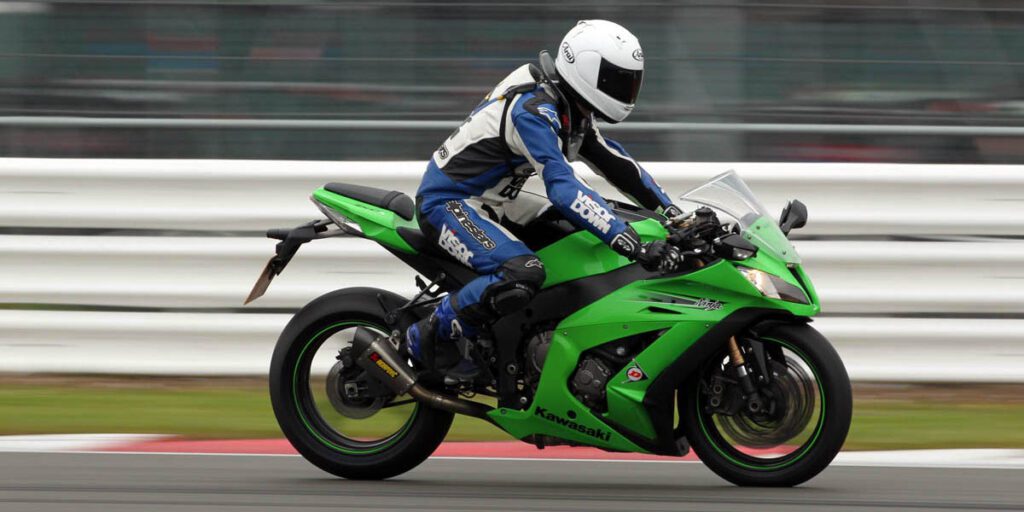
Typical motorcycle tyre mileage (a guide)
While there’s no hard and fast rule, the following mileage ranges give a realistic idea of what many riders experience:
- Sport tyres: roughly 1,500–4,000 miles
Designed for grip rather than longevity, especially on powerful bikes. - Sport-touring tyres: around 3,000–8,000 miles, sometimes more
A good balance of grip, wet performance and durability. - Adventure tyres (road-biased): typically 3,000–6,000 miles
Depends heavily on how much off-road riding is involved. - Adventure tyres (green-lane-spec): typically 2,500–5,000 miles
Tyres with tread blocks wear on the road much faster, especially on heavy Adventure bikes. - Off-road / knobbly tyres: 1,000–4,000 miles often much less on tarmac
Aggressive tread patterns wear quickly on sealed roads. - Cruiser / Harley tyres: 3,000–8,000 miles
This depends on whether the tyres are bias-belted or radial. Most are bias. - Scooter and commuter tyres: 2,000–5,000 miles
Small wheels rotate more for a given distance.
These figures alone aren’t super useful, but they give you an idea. Mileages vary from manufacturer to manufacturer and model to model. You can even see completely different mileages being returned from two bikes that you might think were pretty similar.
What factors have the biggest impact on a tyre’s life?
Riding style
Probably the biggest factor when it comes to a tyre’s life (or lack of it) is in your right wrist. Hard acceleration, heavy braking and aggressive cornering all generate heat and scrub rubber away faster. Smooth riding generally extends tyre life.
Bike power and weight
High-torque bikes, especially those with a strong mid-range, can destroy rear tyres quickly. Heavy touring bikes also put more load through the tyres than an equivalent Sportsbike. KTM Superduke 1290s are guilty of punishing tyres. Bikes like Honda’s NC750 seem to just tickle them.
Tyre pressure
Incorrect pressures can definitely cause premature wear, which is why we recommend you check your pressures at least once a month.
- Under-inflation causes excess heat and rapid wear.
- Over-inflation can reduce grip and cause uneven wear.
The right pressures not only improve a tyre’s lifespan but also make the bike handle so much better.
Surface conditions and environment
Rough road surfaces, frequent motorway use and extreme temperatures all affect how quickly tyres wear. If you’re doing high speed motorway miles on a big bike, you’ll kill the central section of a tyre and have to replace it, despite 70% of the tyre having lots of life left. If you use a Sports tyre on a trackday, you might get as little as 300-miles from it, where the same tyre might return 4,000 miles on the road.
Radial vs Bias
Most modern tyres are radial in their construction, but cruiser tyres and some others, like off-road tyres are bias-belt. The bias construction gives a plusher ride and can often help the tyre find more grip. However, it doesn’t hold up as well as a radial when it comes to mileage.
r
Tyre age vs tyre wear
A common mistake is judging tyres purely by how much tread is left. An older tyre that looks to have plenty of tread may also need replacing. It’s not quite as obvious as when you can see the carcass but an old tyre may not offer the grip you need.
Motorcycle tyres age even if they aren’t worn out. Over time, the rubber hardens due to:
- UV exposure
- heat cycles
- oxidation
This means a tyre can look fine but offer noticeably less grip, particularly in wet or cold conditions.
As a general rule, we recommend fitting a tyre before it is 5 years old and replacing it before it is 10 years old. You can see the age of the tyre by looking for 4-figure stamped on the sidewall on one side of the tyre. For example 4625 means it was made in the 46th week of 2025.
Signs your motorcycle tyres need replacing
Regardless of mileage, tyres should be replaced if you notice:
- tread worn down to the wear bars
- squared-off rear tyre affecting handling
- cracking or perishing in the rubber
- uneven wear or cupping
- reduced grip, especially in the wet
- vague or unstable handling
If the bike no longer feels confidence-inspiring, the tyres are often the cause. Check the pressures first, then check out the condition of the rubber, then check the date code. If in doubt it’s always best to replace your tyres.
Front vs rear tyre lifespan
Rear tyres almost always wear faster than fronts due to acceleration forces. Front tyres often age out before they wear out, which is why many riders replace the front based on age or feel rather than tread depth alone. It used to be that you could get two rears to a front tyre, but these days the manufacturers make the fronts that bit softer, to offer faster warm-up times and more grip. That means your front will often be fairly close to needing replacing when your rear is past best. It’s unlikely you’ll get two rears to every front if you fit a Sports or Sports Touring tyre.
Some riders replace tyres as a pair for balanced handling, while others replace them individually depending on wear. You don’t get the full benefit of that “fresh tyres feeling” if you only replace one tyre but we understand that money is a deciding factor for most.
So, how long should motorcycle tyres last?
There’s no single correct answer — but there is a sensible approach:
- expect mileage to vary based on tyre type and riding style
- don’t judge tyres on tread depth alone
- pay attention to age, grip and handling feel
- keep tyre pressures correct
- choose tyres that suit how you actually ride, not just how long they last
Ultimately, tyres are the only thing connecting your bike to the road. Replacing them at the right time improves safety, handling and enjoyment far more than squeezing out the last few hundred miles.
