
A good motorcycle puncture repair kit should do two things: seal the hole and put enough air back into the tyre to get you moving.
For most tubeless motorcycle tyres, our first choice is a string-type repair kit. It is simple, compact and capable of sealing the usual nail or screw puncture in a few minutes. Stop & Go-style mushroom plugs are another good option, particularly if you want a cleaner system without separate rubber solution.
What we would avoid—except as a genuine last resort—is filling the tyre with foam or liquid sealant. It may get you moving, but it also makes a subsequent professional repair extremely difficult and, in practice, most motorcycle workshops will refuse to do it.
All roadside repair kits are temporary but some riders keep them for the life of the tyre. If you use a kit, rather than a foam or sealant, you can get yourself out of trouble and then head to your local bike shop, who will be able to drill out your temporary plug and replace it with a mushroom plug from the inside. This professional repair will then last the lifetime of the tyre.
If you’ve picked up a puncture in a tyre that’s got plenty of life left, this is the route we’d take to getting yourself off the side of the road and getting the tyre properly repaired.
This guide explains the different systems, what each one does well and what we recommend carrying.
What is the best motorcycle puncture repair kit?
For most riders, the best choice is a string-type repair kit with its own inflation equipment. The tools are simple, the repair strings cope well with ordinary nail and screw holes, and replacement plugs, cement and CO2 cartridges are inexpensive.
| Situation | Our recommendation |
|---|---|
| Everyday road riding | String repair kit with CO2 cartridges |
| Clean, glue-free repair | Stop & Go-style mushroom-plug kit |
| Touring and longer journeys | String or mushroom-plug kit plus a portable inflator |
| Motorcycles with inner tubes | Spare tube, tyre levers, wheel-removal tools and a pump |
| Absolute last resort | Foam or liquid sealant |
Our recommended motorcycle puncture repair kit
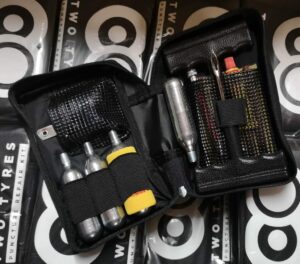
Our Two Tyres Motorcycle Puncture Repair Kit uses the string-repair system because it is simple, reliable and easy to replenish.
It contains five repair bungs, a tyre reamer, insertion tool, rubber solution, trimming blade and an inflation adaptor. We include four CO2 cartridges—three 16g cartridges and an additional 12g cartridge—because the three supplied in many competing kits can leave a large motorcycle rear tyre frustratingly short of pressure.
We also include two hand wipes. That may sound like a small detail, but tyre dirt, rubber solution and expensive motorcycle gloves are not a happy combination.
- Five quality repair strings
- Tyre reamer and insertion tool
- Rubber solution
- Three 16g CO2 cartridges plus an additional 12g cartridge
- CO2 inflation adaptor
- Blade for trimming the repair
- Two hand wipes
- Compact 16cm × 11cm × 7cm storage case
- Three-year warranty
For everyday riding, it is a compact all-in-one solution. For touring, we would combine it with our cordless motorcycle tyre inflator.
View the Two Tyres Motorcycle Puncture Repair Kit
String-type puncture repair kits
String repairs—also called rope plugs, worms or bungs—are our preferred all-round roadside solution for tubeless motorcycle tyres.
Remove the nail or screw, clean and prepare the hole with the reamer, coat the repair string with rubber solution and force it into the tyre using the insertion tool. Trim the excess, reinflate the tyre and check that the repair is airtight.
It is a simple mechanical repair with very little to go wrong. Strings work particularly well on the ordinary round punctures caused by nails and screws, including holes that enter the tread at a slight angle.
Another advantage is that the repair does not necessarily prevent the tyre from being professionally repaired later. A tyre fitter can drill out the string, inspect the tyre internally and, if the damage is suitable, install a professional mushroom patch from the inside.
This is why we prefer strings to foam and liquid sealants: the roadside repair gets you moving without filling the tyre with something that makes a proper subsequent repair almost impossible.
Advantages of string repairs
- Simple, inexpensive and widely available
- Few components to lose or break
- Good on straight and slightly angled punctures
- Another string can be inserted if the first does not seal completely
- Replacement strings and rubber solution are inexpensive
- The string can be drilled out if the tyre is suitable for a professional internal repair
Disadvantages of string repairs
- The repair can be sticky and messy
- Reaming a steel-belted tyre takes more effort than you might expect
- You still need CO2 cartridges, a pump or another way to reinflate the tyre
Stop & Go-style mushroom plugs
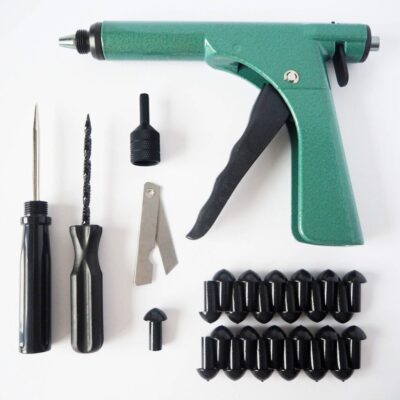
Stop & Go-style kits use a rubber mushroom plug inserted through the puncture from outside the tyre. The stem fills the hole while the mushroom-shaped head opens against the tyre’s inner surface.
They are clean, compact and don’t require separate tyre cement. Once you understand the applicator, they are quick to use and produce a neat repair.
We think they are a perfectly good alternative to conventional strings. String kits are cheaper, mechanically simpler and more forgiving of awkward or angled punctures. Mushroom-plug systems are cleaner and appeal to riders who want a self-contained tool without sticky cement.
Some mushroom-plug kits only repair the hole and contain no means of reinflating the tyre, so check exactly what is included. A beautifully plugged tyre with 8psi in it will not get you very far.
CO2 cartridges or a portable tyre inflator?
Sealing the hole is only half the job. You also need to put enough air back into the tyre to make the motorcycle rideable.
CO2 cartridges
CO2 cartridges win for size and speed. They fit beneath most motorcycle seats, require no charging and can inflate a repaired tyre quickly.
The limitation is capacity. Large motorcycle rear tyres swallow a surprising amount of gas, which is why our kit includes four cartridges rather than the usual three. The cartridges also become extremely cold as they discharge, so use the protective sleeve supplied with the kit.
Once the cartridges have been used, replace them before the kit goes back under the seat. Our CO2 top-up pack contains five 16g cartridges and works with our own kit as well as many Oxford, Gear Gremlin and Bike It inflators.
You’ll find that our cartridges will inflate a typical 180-section rear tyre to around 28psi – plenty to get you moving. We’d then advise you head to a petrol-station pump and top up your tyre to the correct pressure.
Portable rechargeable inflators
A portable inflator is bulkier than a handful of CO2 cartridges, but it does not give you one attempt and then become an empty metal tube.
Our cordless motorcycle tyre inflator can inflate a motorcycle tyre from flat to 30psi in under three minutes. Its 5200mAh battery can inflate up to four tyres between charges and it can be recharged by USB.
It also doubles as a power bank for charging a phone, sat-nav or intercom. The built-in torch, red light and flashing SOS mode are genuinely useful if the puncture happens after dark.
Our ideal touring setup is therefore a proper plug kit plus a charged portable inflator. The CO2 gets air into the tyre quickly; the inflator lets you set the final pressure accurately and top it up again later.
Why we don’t recommend tyre foam or sealant
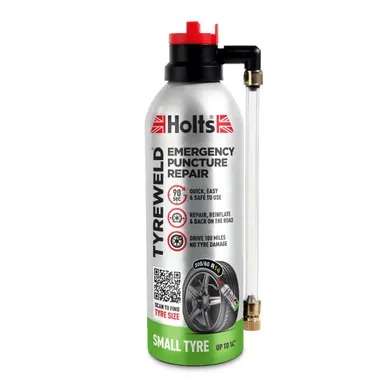
Foam and liquid sealants look appealing because there are no tools and no plug to insert. Connect the container to the valve, fill the tyre and hope the liquid finds the puncture.
The problem comes afterwards.
A professional motorcycle tyre repair normally involves removing the tyre, preparing the damaged area and installing a combination mushroom patch from the inside out. If the tyre has been filled with foam or liquid sealant, its inner surface must be cleaned thoroughly before the patch can bond correctly.
In practice, that is difficult, messy and time-consuming. Most motorcycle workshops won’t attempt it. A puncture that might originally have accepted a professional repair can therefore become a replacement tyre.
By contrast, an external string can be drilled out, allowing the tyre to be inspected and professionally repaired if the position, size and condition of the damage permit it.
Foam is better than being stranded, but it should be the last option rather than the first thing you reach for.
What if your motorcycle has inner tubes?

External strings and mushroom plugs repair tubeless tyres. If your motorcycle uses inner tubes, pushing a plug into the tyre will achieve absolutely nothing: the air is escaping from the punctured tube inside it.
The proper trail-side solution is to remove the wheel and tyre, repair or replace the inner tube and reinflate it. That means carrying suitable wheel-removal tools, tyre levers, a patch kit or spare tube and a pump.
For a road bike with tubed tyres, recovery is often the realistic option. For trail and adventure riding, learning how to replace a tube before setting off somewhere remote is time very well spent.
For more information on tube types, sizes and valves, read our motorcycle inner tubes guide.
Which motorcycle punctures can be repaired?
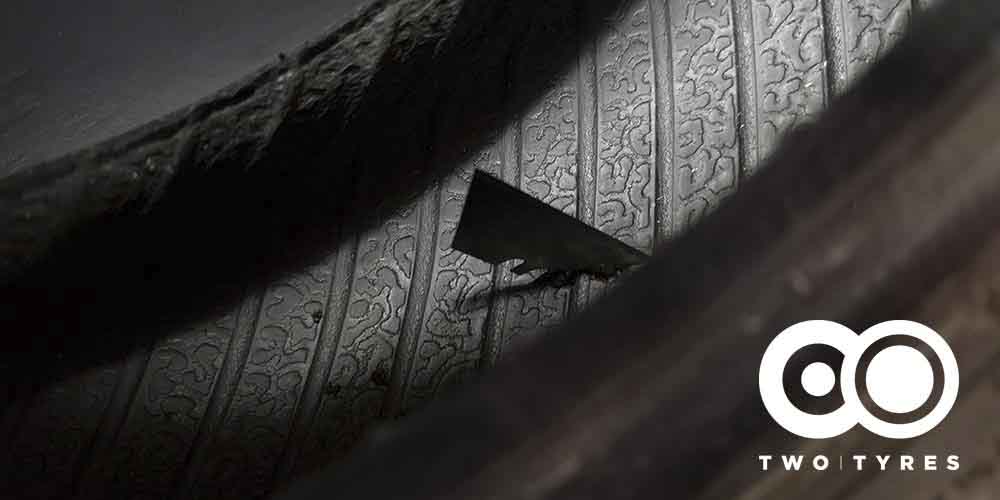
Roadside plug kits are intended for straightforward penetrations through the main tread area—the classic nail or screw puncture.
Do not try to plug:
- A cut or tear
- Sidewall damage
- Damage close to the edge of the tread
- A tyre that has come away from the rim
- A damaged or badly bent wheel
- Multiple closely grouped holes
- A tyre that has been ridden flat and damaged internally
- A badly worn, perished or otherwise damaged tyre
If the tyre has simply picked up a clean nail or screw through the main tread, that is exactly the sort of puncture these kits are intended to deal with.
If the object is still in the tyre and it is only losing pressure slowly, don’t automatically pull it out before you have the tools and inflation equipment ready. Removing it can turn a slow leak into a completely flat tyre.
How to repair a tubeless motorcycle tyre with a string
- Stop somewhere safe. Do not attempt a repair on a motorway hard shoulder or anywhere exposed to passing traffic.
- Find the puncture. Check that it is within the main tread and suitable for plugging.
- Remove the object. Pliers are useful for extracting a deeply embedded nail or screw.
- Prepare the hole. Push the reamer through the puncture several times to clean and open it sufficiently for the repair string.
- Load the string. Thread a repair string through the insertion tool and apply rubber solution.
- Insert the repair. Push the string firmly into the tyre, leaving a small amount outside.
- Withdraw the tool. Follow the kit’s instructions so the string remains securely in the tyre.
- Trim the excess. Cut the protruding material close to the tread.
- Reinflate the tyre. Use the supplied CO2 cartridges or a portable pump.
- Check for leaks. Listen for escaping air or use soapy water if it is available.
- Recheck the pressure. Stop after a short distance and confirm that the repair is holding.
Watch our video: How to fix a motorcycle puncture.
Roadside plugs and professional internal repairs
A roadside string or external mushroom plug is installed without removing the tyre. It seals the hole and gets the motorcycle moving again, but it does not allow you to inspect the inside of the tyre for hidden damage.
A professional repair is different. The tyre is removed from the wheel and inspected internally before a combination mushroom patch is installed from the inside out. Its stem fills the puncture channel while the patch seals against the prepared inner liner.
A string repair can normally be drilled out before this work is carried out. Whether the tyre can then be professionally repaired depends on the location and size of the puncture, its speed rating, previous repairs and the condition of the tyre.
If you are near London, our workshop offers a professional motorcycle puncture repair service. We remove and inspect the tyre before deciding whether it is safe and legal to repair.
Don’t let the roadside be your first attempt
A string kit is simple to use, but forcing a reamer and repair plug through a steel-belted motorcycle tyre takes more effort than most people expect.
When your next worn-out tyre is being replaced, use it for practice. Put a screw through the main tread, pull it out and repair the hole. Five minutes spent practising on a scrap tyre is worth more than reading twenty pages of instructions in the rain. Or if you’re inclined, visit your local bike shop and use one of their scrap tyres – they’ll no doubt let you get stuck in.
Check the kit periodically too. Make sure the rubber solution hasn’t dried out, the blade hasn’t gone rusty, the cartridges haven’t been used and every tool has made it back into the case.
Motorcycle puncture repair kit FAQs
What is the best type of motorcycle puncture repair kit?
For most tubeless motorcycle tyres, we recommend a string-type repair kit containing a reamer, insertion tool, rubber solution, repair strings and its own inflation equipment. Stop & Go-style mushroom plugs are also a good, cleaner alternative.
Are motorcycle puncture repair kits suitable for inner tubes?
No. External strings and mushroom plugs repair tubeless tyres, not punctured inner tubes. A tubed wheel normally requires the wheel and tyre to be removed so the tube can be patched or replaced.
Can a string repair be removed later?
Yes. A tyre fitter can drill out a string repair before inspecting the tyre and, where permitted, installing a professional mushroom patch from inside the tyre.
Will tyre foam stop a professional repair being carried out?
Usually, yes. Foam or liquid sealant contaminates the tyre’s inner surface, making it difficult to prepare properly for an internal patch. Most motorcycle workshops will decline the job rather than attempt to clean it.
How many CO2 cartridges do you need for a motorcycle tyre?
It depends on the cartridge size and the volume of the tyre. Large rear tyres require more gas than many compact kits provide. Our kit contains three 16g cartridges plus an additional 12g cartridge to provide more usable pressure than the common three-cartridge setup.
Is a portable inflator better than CO2?
It is more versatile but takes up more room. CO2 is extremely compact and fast; a rechargeable inflator can set the pressure accurately, top the tyre up again later and be reused. For touring, we would carry both.
Can you repair sidewall damage with a plug?
No. A cut, split or puncture in the sidewall is not suitable for a roadside plug or professional puncture repair. The tyre needs to be replaced.
Should I remove a nail from my motorcycle tyre immediately?
Not unless you are ready to repair and reinflate the tyre. The nail may be partially sealing the hole, and removing it can turn a slow puncture into a flat tyre.
What should I carry on a motorcycle tour?
For a tubeless motorcycle, we would carry a string or mushroom-plug kit, a portable inflator, a separate pressure gauge and enough replacement plugs to allow for more than one attempt. If the bike uses tubes, carry appropriate tyre levers, wheel-removal tools, a spare tube or patches and a pump.
Our recommended puncture-repair setup
For everyday riding, start with the Two Tyres Motorcycle Puncture Repair Kit. It contains the repair tools, five strings and four CO2 cartridges in one compact case.
For touring or riding somewhere remote, add the Two Tyres Cordless Motorcycle Tyre Inflator. It provides repeatable inflation, a power bank for your devices and a built-in roadside torch.
